Technology Policy - Telangana
Tracking Telangana's Ambition: Introducing the Telangana Rising 2047 Board
Translation is unavailable right now. This article is still readable in English.
As nations globally race to secure leverage across the AI value chain, India’s story is being written not just in New Delhi, but across its state capitals. Among the states charting their own technology and economic futures, Telangana stands out with a vision that is both sweeping in its ambition and grounded in a structured strategy.
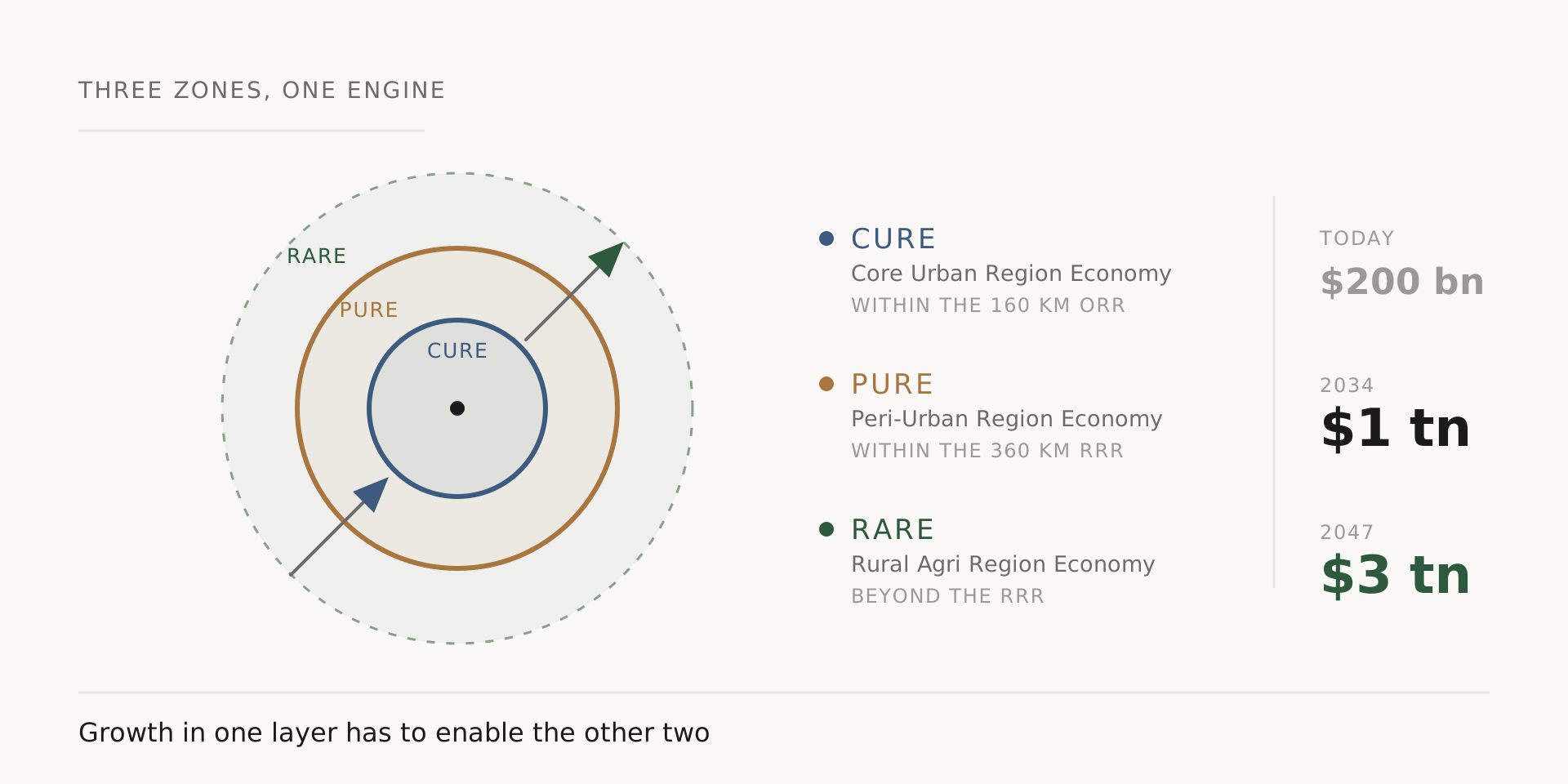
The Telangana Rising 2047 vision document captures the political history and the contributions of every century, from the Satavahanas to the Nizams to the modern state, where it claims to be at an inflection point, ready for exponential growth. It sets an ambition to become a US$1 trillion economy by 2034 and US$3 trillion by 2047, from the current US$200 billion.
Three Zones, One Engine
The architecture to get there is built on three interlocking economic zones: CURE, the core urban economy within the 160-km Outer Ring Road; PURE, the peri-urban manufacturing belt within a 360-km Regional Ring Road; and RARE, the rural agricultural economy beyond.
For those familiar with international relations theory, the structure resembles Immanuel Wallerstein’s World Systems Theory, with its core, semi-periphery, and periphery. However, Wallerstein’s framework describes a system of economic dependency, in which the periphery’s underdevelopment is a condition of the core’s growth. Telangana’s layered zones are conceived instead as an engine of mutual growth, with technology as the connective tissue. That distinction is the whole wager of the document, and it is the part that will be hardest to hold.
The Ground the Vision Stands On
The state’s Socio-Economic, Educational, Employment, Political, and Caste (SEEEPC) survey anchors the vision in sobering ground realities.
Over 63% of residents live in cramped housing conditions. Against these numbers, the vision’s technology-first strategy must be read carefully. The SEEEPC survey flags healthcare access, quality education, employment, and transparent governance as the state’s most pressing priorities — not as aspirations, but as prerequisites.
There is, however, a bright spot: school dropout rates across castes remain below 10%, against a national secondary-level average of 17.2%. That is an indicator of latent human capital the vision must actively cultivate rather than assume.
The Integration Test
The vision’s most critical test will not be in how well each zone performs independently, but in how seamlessly they are integrated. AI and IoT services developed in CURE must flow into the manufacturing corridors of PURE and the agricultural landscapes of RARE.
Japan’s Society 5.0, which envisions a deep fusion of digital infrastructure with social and economic life, offers a useful conceptual anchor. Telangana’s three-zone strategy needs an equivalent overarching principle: development in one layer must actively enable the other two. Without it, three zones are simply three separate economies that happen to share a state government.
The net-zero commitment warrants the same scrutiny. Currently framed primarily around the CURE urban economy, the policy must extend its environmental agenda across PURE and RARE as well. A green urban core sitting alongside industrially polluted peripheries would be a structural contradiction, not a success story — and it would return the arrangement to precisely the dependency model the three-zone framing sets out to avoid.
Technology developed in CURE flows outward into PURE manufacturing and RARE agriculture. Environmental commitments apply statewide. Each zone's gains raise the others.
CURE captures the technology dividend and exports its pollution burden outward. PURE and RARE supply labour and land. The periphery's position underwrites the core's growth.
Introducing the Telangana Rising 2047 Board
At SSL, we believe that vision documents are only as valuable as the accountability structures built around them. That is why we are launching the Telangana Rising 2047 Board — a tracking dashboard that maps the state’s policies and initiatives against their envisioned outcomes.
The Board is designed for organisations and researchers who want to move beyond headlines and engage rigorously with Telangana’s development trajectory. We will track what is announced, what is implemented, and what outcomes are actually delivered, creating a living record of the state’s journey from US$200 billion to US$3 trillion. It sits alongside our Telangana Tech Policy Tracker, which follows the state’s individual technology policies through their milestones.
Telangana’s ambition deserves both celebration and scrutiny. We intend to provide both.
If your organisation or research agenda intersects with Telangana’s development story — whether in technology policy, economic development, education, or governance — we would like to collaborate. Reach out to us. Let’s build the accountability layer that this vision deserves.