Technology Policy - Telangana
Telangana Should Build IT Ecosystems for Digital Development, Not Fiscal Incentives
Translation is unavailable right now. This article is still readable in English.
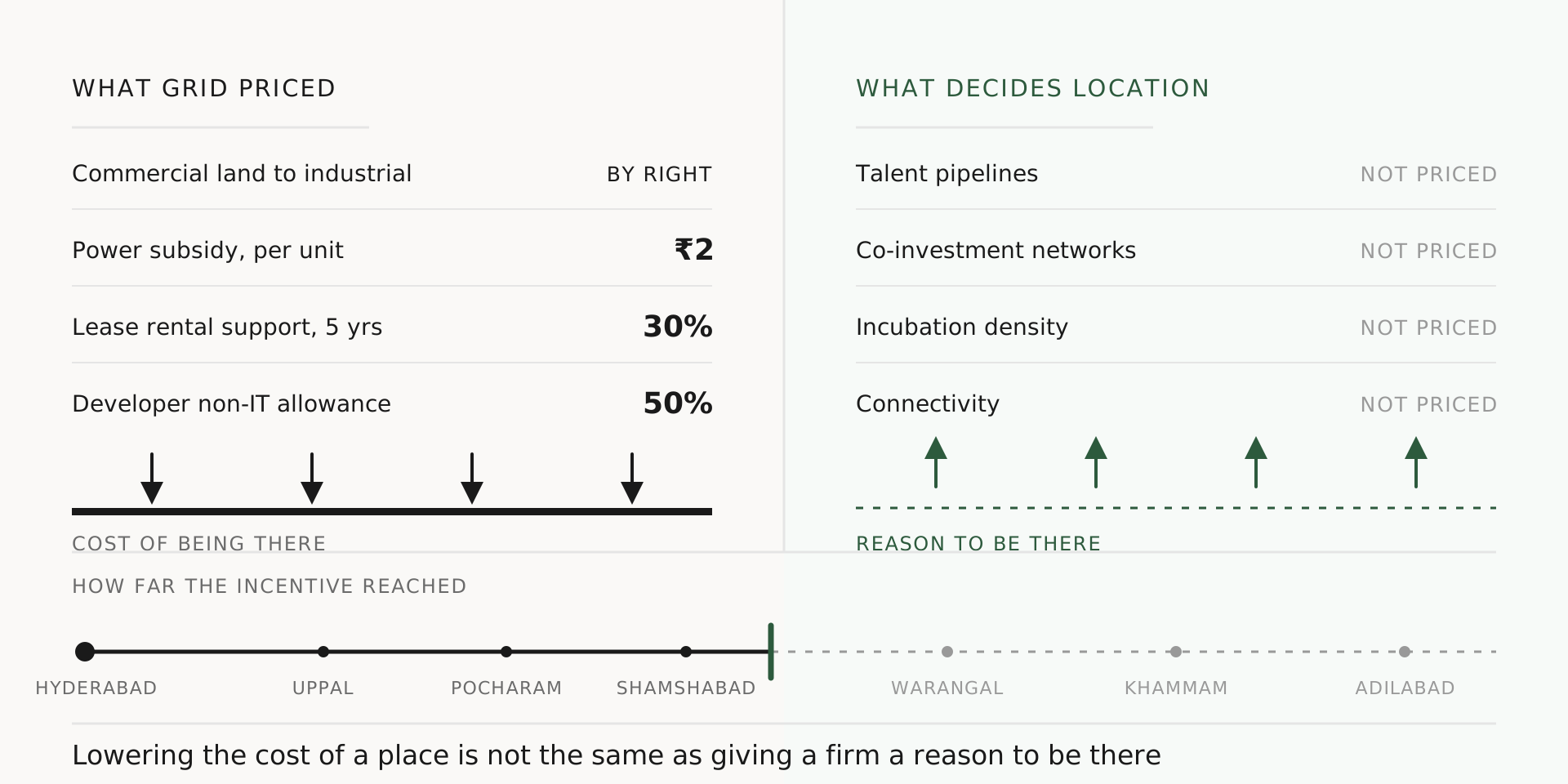
In an era where AI and internet infrastructure have become foundational to socio-economic activity, restricting IT industry to one city limits holistic digital adoption and AI-oriented economic development across the state. Telangana precisely has this structural problem of IT concentration in Hyderabad. Even though Telangana occupies second position in IT/ITES exports with total worth approx. INR 2.4 lakh crore in FY 2023-24, the overwhelming share of this IT output originates from the Gachibowli-Madhapur-HITEC City belt.
Telangana’s Growth in Dispersion (GRID) policy, operationalised under the ICT Policy 2021-26 and now lapsed with the policy’s expiry in March 2026, was the state’s attempt to redistribute IT growth beyond the Cyberabad corridor. But the policy scratched the surface — it fell back to encouraging investments within the greater Hyderabad region, expanding the IT sector into peripheral zones including Uppal, Pocharam, Kompally, Kollapur, and Shamshabad. The question to ask is whether expanding only to the peripheral zones of Hyderabad is enough for holistic technology-oriented development of Telangana.
A Supply-Side Policy
The GRID policy was supply-side in character: automatic conversion of commercial land to industrial classification; a power subsidy of INR 2 per unit per year (capped at INR 10 lakh); lease rental support of 30% for five years for new units (capped at INR 10 lakh per year), with a 5% top-up for relocating existing units; and a developer provision permitting 50% non-IT use including residential development on converted industrial land. These are cost-reduction instruments. They lower the friction of relocating to a new zone; they do not generate the pull factors that determine why firms choose cluster locations in the first place. This makes expansion within the outer periphery of Hyderabad difficult. The challenge of expanding the sector into districts like Mahbubnagar, Khammam, or Adilabad is correspondingly larger.
The Same Experiment, Run Twice
Telangana is not the only state running this experiment. Karnataka’s IT Policy 2025-2030 deploys a structurally parallel approach to Bengaluru’s saturation — offering 20% capital expenditure support for new IT parks in Mysuru, Mangaluru, Hubballi-Dharwad, Shivamogga, Kalaburagi, and Belagavi under a ‘Beyond Bengaluru’ framework. Karnataka too has not produced a replicable model for ecosystem transfer. Both states are working from the same hypothesis — that fiscal and infrastructure access in new locations can attract firms away from established clusters.
Telangana’s own policy history calibrates this. The ICT Policy 2016 carried explicit ambitions to develop Warangal, Karimnagar, and Khammam as IT satellites to Hyderabad. Infrastructure was built, but IT activity in those cities did not grow proportionally to Hyderabad’s trajectory over the same period. The spatial imbalance that GRID was designed to correct had its roots in the 2016 cycle.
Ecosystem Development at a Different Scale
What Telangana requires is ecosystem development at a different scale. The Telangana Rising 2047 Vision, released at the Telangana Rising Global Summit in December 2025, frames this through an interconnected economic geography: CURE — the Core Urban Region within the 158-km Outer Ring Road; PURE — the Peri-Urban Region within the 340-km Regional Ring Road; and RARE — the Rural and Agricultural Region beyond. This framework offers the right spatial logic for IT dispersal — because it ties technology development to the economic geography of each ring, rather than treating the state as a single expansion zone radiating from Hyderabad. But frameworks require institutional follow-through, and institutional follow-through requires political continuity across election cycles. For a holistic and sustainable digital economy, Telangana must institutionalise the CURE-PURE-RARE framework and build a horizontal digital ecosystem that addresses existing socio-economic challenges — and that can be replicated elsewhere in the country. That, more than the incentive design of any single policy, is what will determine whether Telangana’s IT geography looks different in 2035 than it does today.