Technology Policy - Telangana
Telangana should build 3 tiered AI Safety Institution
Translation is unavailable right now. This article is still readable in English.
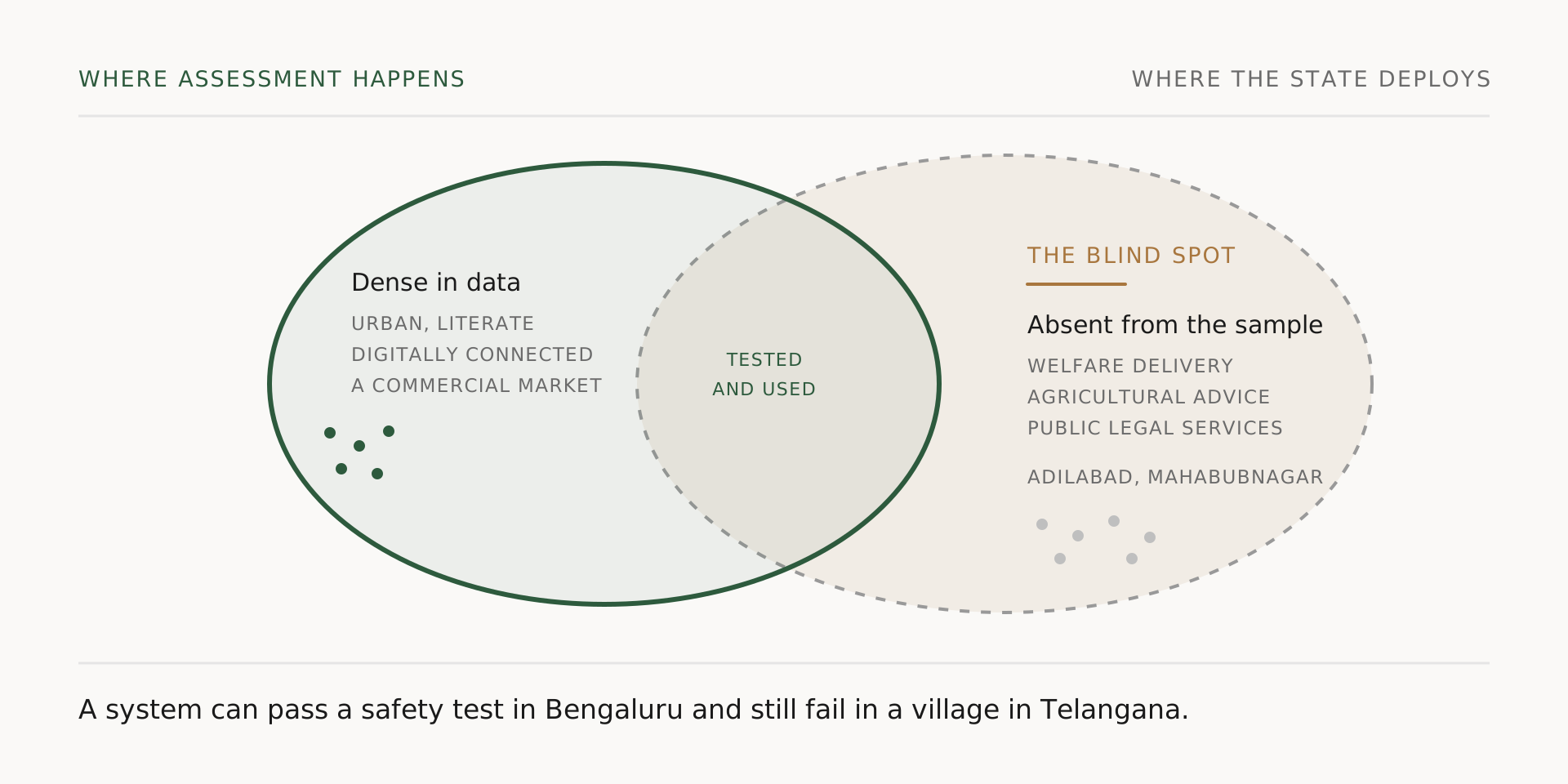
India is building its AI Safety Institute (AISI) in a hub-and-spoke model but risks developing a blind spot. An AI system can pass a safety test in Hyderabad and still fail in a village in Telangana. The people and communities who are least represented in datasets, least attractive as commercial markets and hardest to reach institutionally may also be the people least likely to be included in AI safety assessments.
Accordingly, an AI system used for welfare delivery by the state can encounter communities that were absent from its training data, validation samples or pilot programmes. Therefore, a system which ranks high in the evaluation and testing prior to deployment will perform poorly in the environments where the state ultimately deploys it.
India’s emerging AI safety architecture needs to account for this gap before it is too late. In order to do that, safety assessments have to differentiate model level governance and non-model level governance. Model level includes assessments of whether an application meets technical standards: whether it is accurate, robust, explainable, secure or biased in measurable ways. Non-model level includes assessment of how the fine tuned model behaves in its deployment context: Does the system work in the language actually spoken by users? Do people understand its recommendations? Do local officials use it as intended? Does unreliable connectivity alter outcomes? Does the introduction of the system change how citizens access a service? Are there harms that appear only after deployment? Answers to these questions require access to communities over time and dynamic assessments.
AISI should develop standardised AI safety assessments that capture how AI systems perform when deployed among populations that were not part of the training, validation, or pilot sample. These require methodologies and institutional positions relative to the communities being assessed, and relationships with the local population.
A three-tier model for Telangana
The national institution would not need to know every community. The state network would not need to reinvent national safety standards. And civil-society organisations would not need to develop their own technical evaluation frameworks. What we require is a coordinated approach, distributing the responsibilities.
We propose a three tiered AISI for Telangana. The first tier would be a research anchor. An institution such as IIIT Hyderabad or IIT Hyderabad would develop and maintain the technical methodology, establish assessment protocols and coordinate with the national AISI. The second tier would be a statewide research network. Universities and research institutions across Telangana could adapt the methodology, fine tune to the local conditions and identify communities and public services requiring assessment. The third tier would be community organisations. Civil-society groups with established field relationships could conduct structured assessments among target populations and report findings to the research institutions. The reporting cycle should be public and regular. Findings could identify the system tested, the population assessed, the deployment context, observed failures and recommended mitigations. Over time, this would create something India currently lacks: an evidence base on how AI performs across the country’s social and geographic diversity after it leaves the laboratory.
- NationalIndia AI Safety InstituteModel level assessment
Whether an application is accurate, robust, explainable, secure or biased in measurable ways.
- Tier 01Research anchorIIIT Hyderabad / IIT Hyderabad
Develops and maintains the technical methodology, establishes assessment protocols, and coordinates with the national AISI.
- Tier 02Statewide research networkUniversities and research institutions across Telangana
Adapts the methodology, fine tunes it to local conditions, and identifies communities and public services requiring assessment.
- Tier 03Community organisationsCivil-society groups with field relationships
Conducts structured assessments among target populations and reports findings to the research institutions.
The larger opportunity
India’s AI governance architecture is still being built. That makes this the right moment to decide what “safe” should mean. An AI system should not be considered adequately assessed simply because it performs well on the populations for which data is abundant.
For public-facing AI, safety should also mean understanding what happens when a system encounters people who were never part of its development process. That is why community-level assessment should not be treated as an optional extension of AI safety. It should become part of the country’s safety infrastructure. The objective is not to decentralise AI regulation. It is to decentralise the evidence on which AI governance depends.
India’s national AI safety institution can set the standards. But if it wants to know whether AI is safe for the people who will actually use it, it will need the proposed three tiered operational setup.