Technology Policy - India
Free Online Coaching Is Not an Education Policy or an Alternative
Translation is unavailable right now. This article is still readable in English.
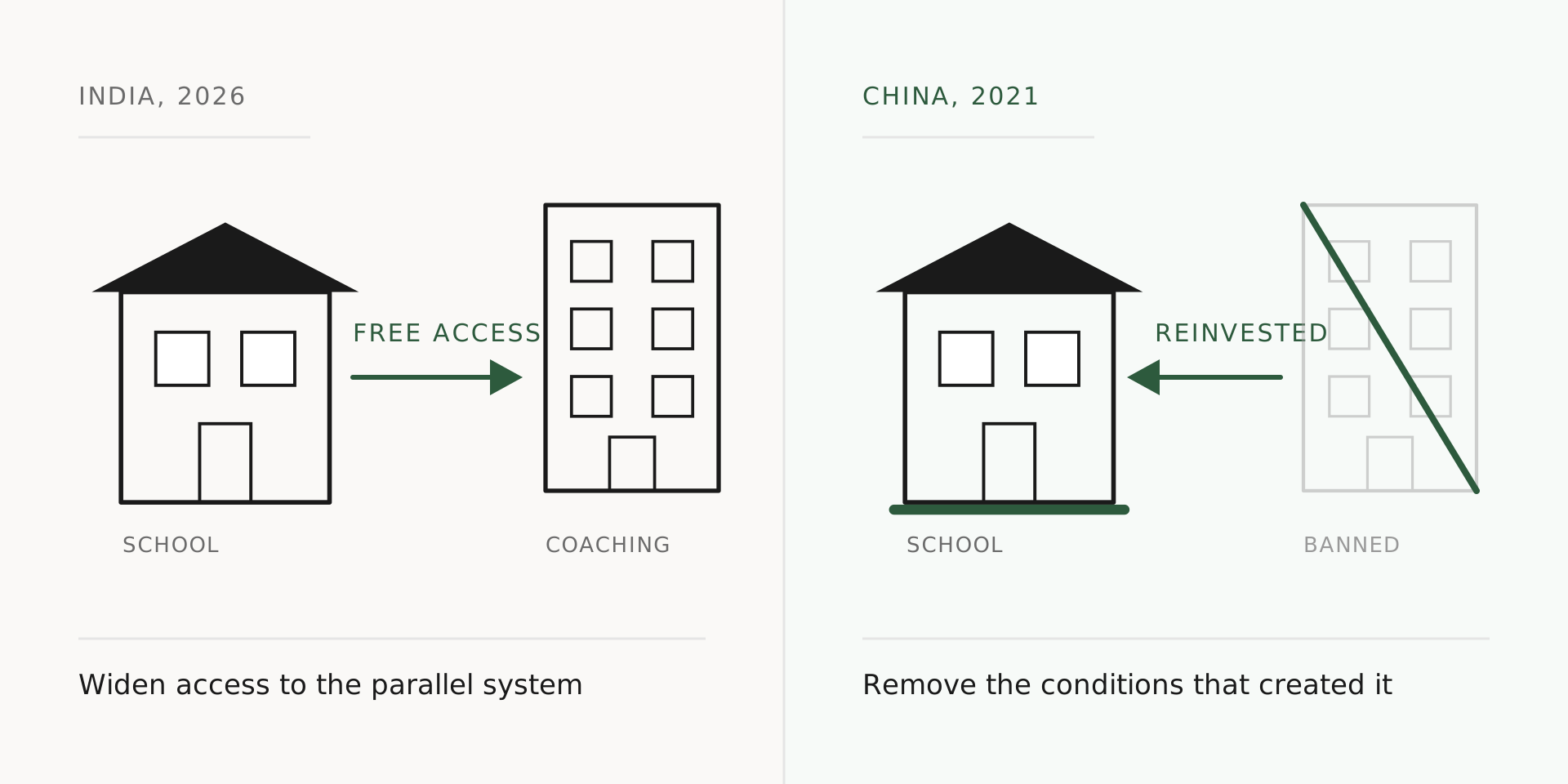
Prime Minister Modi’s 80th Independence Day address from the Red Fort carried a notable announcement alongside the Sapta Dhara framework. It is free online coaching for competitive examinations. The intent behind this is to provide an equitable platform for every aspirant in the country by reducing the financial burden on poor and middle-class families who spend on coaching. However, the government which should ensure that the existing system sufficiently trains students to compete in these examinations is instead building a parallel education system alongside it.
Indian households spent USD 7.2 billion on coaching in 2025, a figure projected to reach USD 17.8 billion by 2034 at a CAGR of approximately 10%. That figure is not merely the revenue of an industry. It is the money families pay a second time, out of pocket, for preparation that state-funded schooling was supposed to provide in the first place. Households are financing the shortfall of the public education system, and the size of that shortfall is now large enough to be measured in billions of dollars a year.
The problem with the free online coaching announcement is one of policy substitution. When formal education institutions fail to prepare students adequately for national-level examinations, the policy response should address that institutional gap. Instead, the government is now entering the coaching market not to reform it, but to replicate it in the public domain. This moves the state from being the regulator of a parallel education system to being one of its operators.
The scale of that parallel system is now measurable in official statistics rather than industry estimates alone. The Ministry of Statistics and Programme Implementation’s Comprehensive Modular Survey: Education, conducted in 2025 as part of the 80th round of the National Sample Survey, found that 27% of students were taking private coaching — up from roughly 20% in 2017–18. Urban households spent an average of ₹3,988 per student annually on coaching against ₹1,793 in rural areas, a gap that compounds the very inequality the free coaching announcement is meant to address.
What that spending buys is a place in a queue, not a reasonable prospect of selection. In the 2023 Civil Services Examination, 1,016 candidates were finally recommended out of approximately 5.6 lakh who sat the preliminary stage. The Economic and Political Weekly’s study of the coaching sector records comparably narrow ratios elsewhere: about 1% for JEE Mains and 4% for NEET in 2023. These are the odds that sustain a ₹58,000 crore industry.
China’s Double Reduction: A Structural Reorientation
In July 2021, the General Office of the Central Committee of the Chinese Communist Party and the State Council jointly released the “Opinions on Further Reducing the Burden of Homework and Off-Campus Training for Students in Compulsory Education”, widely referred to as the Double Reduction (双减) policy. The policy did two things simultaneously: it restricted private, for-profit academic tutoring for K-12 students, and it mandated that public schools improve the quality of in-classroom instruction and after-school services. Under this policy, for-profit tutoring in core academic subjects was banned. Existing institutions were required to convert to non-profit status or exit. Tutoring on weekends, national holidays, and school vacations was prohibited. The result was that off-campus training institutions that offer curriculum subject programs have been reduced by 83.8%, and online training institutions have been reduced by 84.1%.
The stated goals of the policy are to prevent household socioeconomic status from determining educational outcomes, to reduce the cost of raising children (a contributing factor to China’s declining birth rate), and to shift the locus of education back to the formal school system. Strengthening the existing system, China redirected online learning toward vocational and skills development. The Ministry of Education released 914 high-quality vocational training courses in 2024, covering AI fundamentals, new-energy vehicles, drone technology, and intelligent manufacturing. The 2025–2027 Vocational Skills Training Initiative targets training for over 30 million people in industries aligned with China’s industrial strategy, demand-driven rather than exam-driven.
Provision of coaching outside the school system is the precise intervention that China examined and abolished. The scenario in India is similar but not the same, and is not integrated structurally into the pedagogy when it comes to online education support. Prime Minister Modi announced free online coaching with a similar goal of reducing the financial burden on poor and middle income families. Additionally, India already launched the PM-eVidya portal, onto which this online coaching is added. However, there is a structural difference in terms of how this increases the parallel education but does not complement school education and pedagogy.
The Structural Difference
China’s Double Reduction policy asked: why does a parallel education system exist, and how do we eliminate the conditions that produce it? India’s free coaching announcement asks: how do we make the parallel system more accessible?
The government enters the coaching market as an operator, offering free online classes for competitive examinations through the PM-eVidya portal.
The government bans for-profit K–12 academic tutoring and mandates that public schools strengthen classroom instruction and after-school provision.
Against this background, the announcement of free online coaching does not engage with the institutional conditions that produced the coaching dependency. It does not reform the curriculum gap between what schools teach and what examinations test. Finally, it does not increase the seats or jobs for which the competitive exams will screen the applicants.
What to do next?
If the Sapta Dhara framework identifies technology and innovation as a core national pillar, the corresponding education intervention is not coaching for existing competitive examinations, the new measures should align school curricula with the knowledge and competencies required by the seven focus sectors. Coaching for UPSC or NEET produces aspirants for existing institutional roles. It does not produce the manufacturing workforce, agro-food processing technicians, logistics professionals, or green economy practitioners the Viksit Bharat framework identifies as priorities.
Online coaching, if it is to be offered at all, should act as a supplement to the existing curriculum and pedagogy rather than as a system running alongside it. The obligation the announcement leaves untouched is the one that matters: a school system that prepares its students well enough that a parallel one is not required.